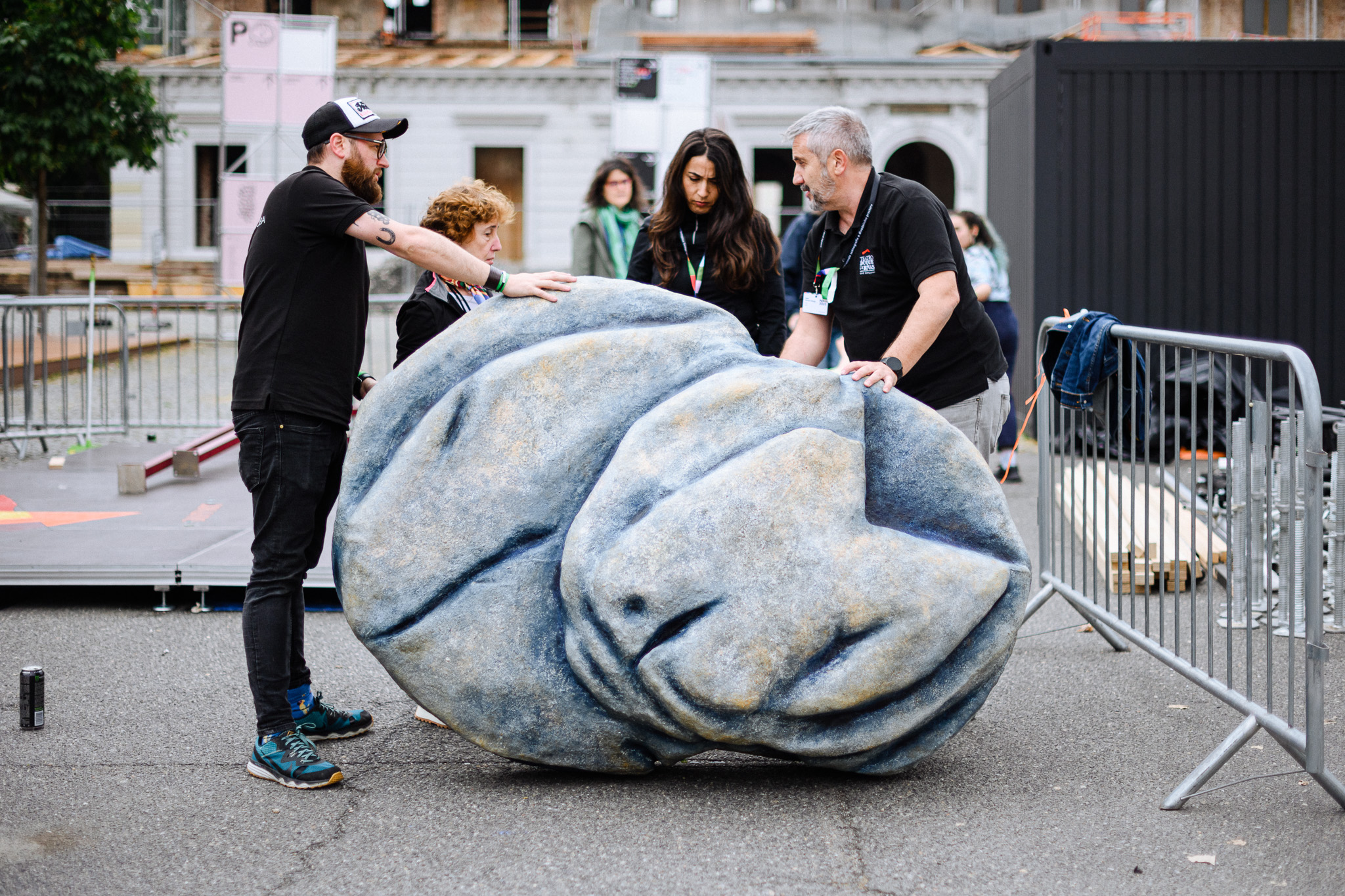
What is it like to coordinate more than 300 projects at an international festival? Take a look behind the scenes of the Prague Quadrennial and read about its production challenges in an interview with PQ General Manager Michaela Buriánková.
The Prague Quadrennial is a stage design platform that showcases classical theatrical means, new media, virtual environments, and interdisciplinary relations to both the general and professional public. It brings together artworks by hundreds of artists from dozens of countries, featuring not only main competitive exhibitions but also other curated projects and accompanying programs.
Overseeing the management of this large-scale event is Michaela Buriánková, who has been the general manager of PQ since 2013. With a wealth of experience in various Czech institutions such as the National Museum and the Academy of Fine Arts in Prague, as well as coordinating projects supported by the European Commission, including those under the Creative Europe program, the European Regional Development Fund, and Erasmus+, she is at the helm of one of the largest events of its kind.
What does the preparation of a festival like PQ actually involve in practice? And how long have you been working on PQ?
The preparation of PQ involves various tasks and processes. It begins with the creation of a new concept, encompassing both artistic and programmatic aspects. Then, the international team members are selected, and efforts are made to secure a suitable venue for the upcoming PQ. Additionally, a grant strategy is developed during this phase. The following year focuses on official announcements, inviting countries and regions to participate in the main exhibitions through diplomatic channels. By this point, key details and the event’s basic schedule and participation requirements are finalized. As PQ draws nearer, communication with interested exhibitors intensifies, open calls for participation in accompanying projects are issued, and production arrangements are handled.
Can you please introduce the different positions and teams involved in PQ?
As the preparations progress, the number of team members grows significantly. While there are around four people in the team during the first year of preparation,  the team expands to nearly fifty members two months before the festival. In total, including volunteers, temporary workers, and external staff, we will have almost two hundred people actively involved in PQ. In addition to the core team, there is an international team of curators responsible for the preparation of accompanying sections of the festival. They oversee the selection of participants and ensure the artistic quality of the chosen works and performances.
Do you also collaborate with foreign artistic teams?
Yes, we collaborate with foreign artistic teams that choose to exhibit in the main sections of PQ. Our communication with these teams typically spans over two years. They are responsible for securing funding for their participation, developing their artistic concept, and presenting their exhibition on site. While the local organizing teams oversee the Exhibition of Countries and Regions, we provide them with extensive cooperation, offering support in terms of facilities and practical implementation of their exhibitions. This includes assistance with sourcing exhibition elements, connecting them with potential suppliers, and providing consultation on technological equipment, among other aspects.
What are the challenges you face when collaborating between different countries and artistic collectives at the festival?
Since PQ is an official event of the Ministry of Culture and the Czech Republic, we approach all participants diplomatically, requiring them to respect each other despite any political or religious differences. While art and theater should respond to global events, we maintain boundaries of respect and professionalism. In exceptional cases where participants cross these boundaries, we work in cooperation with the Ministry of Culture or the Ministry of Foreign Affairs to address the situation. However, such situations rarely happen. Additionally, language communication can be a practical challenge as English is not universally spoken in many parts of the world, despite it being considered a common language.
How do you collaborate with local and international sponsors and partners of the festival?
The four-year gap between each edition poses challenges for developing long-term partnerships because the limited frequency of the event makes it difficult to provide partners with consistent visibility and feedback as compared to annual events. Before the pandemic, we were able to do several actions in collaboration with technology companies specializing in lighting and sound equipment, such as the Czech company Robe that will be participating in the upcoming edition. We have also established a new partnership with Volkswagen’s commercial vehicle division for a joint promotional campaign in public spaces and with Alza that is supporting us with a loan of technical equipment.
How do you assess the quality and impact of the festival?
For professionals in the field of stage and performance design, PQ remains the most significant event in the industry, drawing hundreds of participants from around the world. It serves as a crucial platform for exchanging knowledge, showcasing current trends, and fostering global networking opportunities. While measuring its impact can be challenging, we receive positive feedback after each edition of PQ.
I understand that it may be difficult to answer to the following question but can you pick out the highlights of the festival that are interesting to you personally?
I believe the student program is one of the most progressive and crucial parts of PQ. It offers a unique opportunity for aspiring theatre designers to kick-start their careers. Not only can they participate in workshops and acquire new knowledge, but they also have the chance to showcase their work to an international audience. The student program also facilitates connections with thousands of like-minded individuals who share a passion for theatre.